Saturday, December 17, 2016

Mad Friday!

Week One in Djibouti came to a rather spectacular finish when David’s PhD student Ginevra and her team found an aggregation of five whale sharks which was staying below the surface and had been unnoticed for several hours…
Two of the sharks with Ginevra and her team, photo Luigi de Bacco
Unfortunately Friday is the weekend holiday in Djibouti and so the whale shark area is visited by numerous boats with excited tourists hoping to swim with a whale shark. There were already fourteen of these tourist skiffs searching the area so we knew we had to work fast to get the photo ID shots of these sharks.
Freya in action capturing the ID shots, photo Luigi de Bacco
Guest Jan captures a multi-level whale shark cross-over, photo Luigi de Bacco
So our little team joined Ginevra’s group to get to work. Freya working hard with her Go Pro to get the ID shots, Savi glued to the laser rig to get accurate size images and David mopping up any sharks trying to escape without having their photos taken. MCSS guest Jan was also there with his big SLR camera trying to get images of the whole thing.
Savi in action with the laser measurement rig, photo Luigi de Bacco
Within a few minutes the tourist skiffs had noticed the unusual activity in the corner of the bay and had descended so things started to get very busy very quickly! While our team were somewhat perplexed by the situation with probably more than 20 people in the water; however, the sharks were totally cool about the whole thing and carried on feeding hardly skipping a slurp and deftly swimming between their awkward and eager visitors! Our thanks to Luigi de Bacco, one of the guests aboard the Elegante, Ginevra’s base of operations, for the images in this post.
What on earth is that? Savi, Freya and a shark wonder what has just appeared, photo Luigi de Bacco
So week one ended on a high with a total of 219 encounters recorded, we only have the IDs processed from the first few sessions but already we have 14 individuals sharks photo identified with 7 new sharks and 7 repeat visitors one each from 2009, 2010 and 2014 with four from 2013.

Roll on week two!

Saturday, December 10, 2016

Djibouti December 2016

Well this may be a bit unexpected, but here we are again in Djibouti not knowing what to expect considering the dismal numbers of encounters we had this last January. We set off with high hopes as we decided to come a month earlier since shark numbers had been higher in December the last couple of years; let’s just say we were not disappointed!

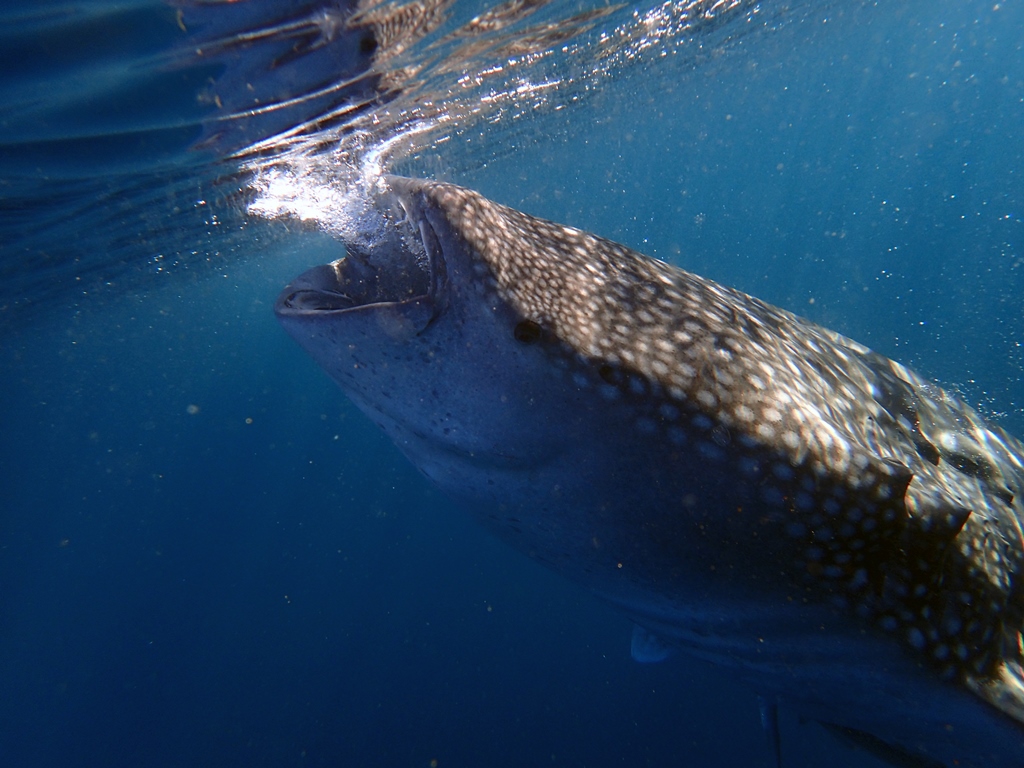
In the first couple of days alone we were back in our element with sharks popping up all over the place displaying a myriad of behaviours. Anything from vertical, Ram, suction, or active surface feeding to swimming, diving, or just being a delightful happy chappy! 
Just hanging around with a few friends
So nice to be swimming with sharks again!
 We were pleased as punch to discover the sharks had returned as this meant more time in the water and less stressful, aching, sun beating times on the Skiff. The spotters gleefully grasped the sides of the vessel, pulled themselves in and rattled all the information they could  to the recorder before jumping back in for the next encounters. 

Though the week was incredible and we revel in every encounter, just a few stand out for the blog readers. The first of which of which is a night shark!!!! All those exclamation points are necessary as it was everything we had heard, read and hoped it was. 

A massive LED light was hung from the ladder off the back of the Deli which accumulated quite a large amount of plankton all trying to fit in the beam yielding a vortex of tiny critters. After an evening of mirth, laughter regarding the return of the spotted fish, one of them decided to take an interest into the aforementioned vortex. “WHALE SHARK” was shouted and individuals either rushed to the edge of the boat to view the event or to their cabins for a quick change into swimming atire. Long story short, this individual decided to stick around and pirouette up the vortex, very much enjoying the meal until 11 o’clock at night! Photographers and whale shark enthusiasts alike were in the water or on the boat staring and mesmerized as the shark unknowingly put on a show many will never forget. 

The night shark investigates the 'vortex' under the light. Photo Warren Baverstock

The second “important” encounter if you will involves one shark who had a terrible run in with some fishing gear. This line had three different hooks and had wrapped around the pectoral fin of a large shark effectively acting as a cheese slicer. David’s PhD student had alerted us regarding this sharks unfortunate accident so we borrowed a divers knife ready for the next encounter. Freya had gone into the water on a standard encounter only to pop up quickly and excitedly mentioning the first drop of the afternoon session had been the injured shark! Rushing into the water to hopefully aid the shark from further damage to the fin (the hooks were well embedded into the flesh causing the dragging line to slowly tear into the pectoral fin causing significant damage to the appendage) so the first move was to remove the dragging line. 

The injured shark with several of the hooks disengaged and the line trailing from the partly severed pectoral fin. Photo Freya

After many salty water filled breaths trying to keep up with the shark, his feeding/swimming patterns and ensuring safe removal of the damaging line, two out of three hooks were removed as well as all of the line! Sadly one hook remains in the flesh of the shark though the damaging line was removed! We’ve seen some amazing quick healing capabilities of these rather amazing sharks. Anything from a dorsal fin being sliced in half from a propeller having healed completely in a year to abrasions recovering to full strength in naught but weeks!
Suction feeding shark, Photo Savi
Djibouti whale sharks back 'on-song'!!
Long story short, this week has restored our faith in the Djibouti Aggregation and we are on the edge of our seats to see what this next week has in store for us.


Saturday, October 1, 2016

Monitoring Updates

Seychelles whale shark programme update 
The Seychelles whale shark monitoring programme has not run since 2014 due to the very low numbers of sharks being encountered thus not generating enough funding to support the activities. Opportunistic sightings are being recorded and currently we have 8 sightings noted so far this season although no aerial surveys have been carried out due to financial constraints. 
One of the Bay Ternay visitors!
Of these we have been able to get photo ID images from North Island and GVI for three sharks one of which, from North Island, was a shark previously known from 2012 (sey.2012.011) and the other two from Bay Ternay were both new individuals, the most recent being on the 19th of September.

Djibouti Monitoring Programme Update

The two week Djibouti monitoring programme was run again this January with support from Dolphin Excursions  aboard the MV Deli for four team members. For the last two years the team has comprised the Chairman Dr. David Rowat, staff member Savinien Leblond, volunteer whale shark team leader Freya Womersley and the volunteer divemaster that runs the whale shark project with Dolphin Excursions in Djibouti, this year it was Christy. For some time we have known that the whale sharks leave Djibouti in late January and so it was unfortunate that this year they left around three weeks early and so very few sharks were encountered. We managed to achieve 16 encounters with 6 individual sharks over the two weeks. 
One of our magnificent six!!
Luckily in the previous two months Christy had recorded 86 encounters with 33 individuals of which 26 were previously identified sharks and only 7 were new sharks, a record resighting rate of 79%! The oldest resighting was of a shark first recorded in 2006. 

During this season we did host a CNN film crew who managed to get in the water with one shark and were able to produce a short documentary which has been aired several times. 

Surface feeding shark
Accordingly the next Djibouti expedition has been scheduled for December (Dec 3-9, 10-16) to ensure we are present at the peak again. This coming season we will be collaborating with the King Abdullah University of Science & Technology in Saudi Arabia as well as supporting a PhD student from the University of Insubria, Italy and taking water samples for bio-genetic studies at University of Copenhagen.

Djibouti Week 2 January 2016 with Savi...

Here we are at week 2 of the Djibouti Whale Shark expedition as we’ve waved goodbye to David Robinson and turned our backs onto the shockingly quiet week 1. Our levels of hope have been on an intense rollercoaster ride as they soar with each whale shark encounter and plummet to the depths each day we are sans spotty fish.
The 'fake shark' made up by highly trained pesky surgeon fish!
This week has brought us quite a few surprises however as we have learned to lower our expectations as we take the spine crushing skiff rides up and down the Djibouti coastline. One particularly gloomy afternoon we had reached the point of where the yellow buoy used to rest and decided to make our way back down the coast towards the Deli. It’s usually at this point when all hope is lost, the fins, mask and snorkel come off and we hang our heads low accepting whale shark defeat. ‘twas a few minutes later whilst dazed and feeling a bit lost that I spotted something up ahead; It was a familiar sight yet felt strange at the same time. This wasn’t a plastic bag shark, it wasn’t a turtle, it wasn’t some seaweed, and it wasn’t those pesky surgeons pretending to be a whale shark; It was an actual whale shark with caudal fin breaking the surface of the water as it was swimming and feeding! After a few seconds of shouting “It’s a real shark!” and letting that moment sink in, I realized I was completely naked in terms of swimming gear and was rather unprepared for the first whale shark encounter during a searching session. Donning all appropriate sharking material and slipping off the skiff into the water, Freya and I set off to photographically capture this animal.  A male of approximately 2.25m (later ID’d to be Mr. 2016.002) was a fast little shark zipping around the roiling seas (well maybe not roiling but it was still windy with sea state 3 seas). We swam with him as long as possible but after many seawater snorkel filled breaths we let him disappear into the greenish waters.
Yes its a real feeding shark!
The following day was but an exceptional one as we received an exciting phone call in the late morning. Christi, the whale shark intern and dive instructor at Dolphin Services, had taken two clients from the Deli to search for our whale shark friend along the coast of Acacia beach. Two had been spotted and we quickly set off for our second search session to join them in the glory of whale sharky goodness. We met up with Mr. 2016.002 who was happily chilling along the shoreline occasionally suction feeding on the remaining arrow worms and other delights in the water column. He was, as David would put it, “a happy chappy” and we were accompanied by the 2nd whale shark! Mrs. 2014.056 had come along to join the fun as she too was cruising the coastline (a bit faster than the feasting male and not munching as often). It was such a spectacular site when these two crossed paths as they carefully avoided each other as if previously rehearsed. Freya and I were naturally wearing our biggest of whale shark grins enjoying this multiple encounter. 

The next few days did not bring the throngs of sharks we believed we would encounter given the trickling start of individuals appearing. We’ve exhausted our search options as we’ve turned to three sessions a day, manta tows and even the weather permitting drone assisted search! Alas, with the water visibility being up to 13m, its clear that the food abundance has drastically decreased and the sharks have found some exclusive buffet to which we are not invited to. 

Though these two weeks have been rather shark quite, we as a team have been quite productive in digging up past data and looking at spatial distribution, shark associations and scarring patterns of the Djibouti aggregations in preparation for the 4th International Whale Shark Conference in Quatar this coming May. We’ve also had time to snorkel and see other favorites of the Tadjourah Reefs such as the blue spotted stingrays, green and hawksbill turtles and even a visit from a devil ray! Despite the whale sharks missing their appointments this trip has been pretty fantastic and we must extend our gratitude once more to Dolphin Excursion Services and the Deli crew for putting up with our whale shark obsessed team of misfits. Until next time!
Farewell Djibouti, until next time!

Djibouti Week One January 2016 with Freya..

The Night Shark

So it’s day three here on the Deli, and so far we’re off to a slow start. After five trips out in the skiff, we haven’t come across a single caudal fin… even with a team of experienced spotters on board (and Savi)! We are all still very hopeful that our spotty friends will join the party soon so we can start getting some individuals identified and added to our shark database.  However don’t fret, it has not been a completely dry start and last night we had a very exciting surprise…

We had installed a powerful LED light at the back of the boat earlier in the evening to see if we could attract some plankton and ultimately a whale shark. After a very quite day, I was secretly unoptimistic so didn’t get too excited about the prospect and after hours of watching fusiliers and a couple of swimming crabs squabbling under the light we decided to call it a day and go to bed.

Obviously the key to spotting sharks is lying on your back with your eyes closed, because that’s exactly when one appeared and it was around 10pm, just as Savi and I had fallen asleep on the deck, that we were swiftly awoken to cries of ‘whale shark!’.

We woke immediately when we heard the commotion and stumbled out of bed to check it out. As we peered over the back of the boat, there it was, the first whale shark I have seen in almost a year, lit from above in a sea of darkness. After the initial awe wore off it was all systems go. In a sleepy haze I grabbed a torch and fumbled around the deck trying to find my equipment whilst not waking the crew. The next challenge was safely leaving the boat as the usual stepladder was raised. This involved clambering under the rails and onto the adjacently parked skiff, not the most graceful of actions but at least it was dark! Once we had made it off the boat we were in the water like a flash, as we didn’t know if the shark would stick around.
The night shark!

We managed to get the left side, but as it dived fairly pronto we were unable to sex it. The encounter only lasted a couple of seconds but it was an unforgettable experience swimming with the worlds largest fish at night, something I never thought I would be lucky enough to do.

Fingers crossed that that was not the last shark we will see, and let’s hope the next couple of days are a bit more productive before we all lose our minds!!

Tuesday, September 22, 2015

The results are in! Role on Djibouti 2016

It is now official! Djibouti 2015 was another epic expedition! The two five-day monitoring sessions netting us a total of  323 encounters with a total of 55 individual sharks, all identified by photo ID. 
A happy little Djibouti shark, with friends!
Of these, 34 were sharks we had seen before in previous years while 21 were new to the programme,  that is close to 62% of site faithful sharks which we believe is the highest level in any aggregation currently studied. Not unsurprisingly the majority of the sharks we saw were male with only 3 female sharks found compared to 51 males (one individual was a bit too speedy and we did not get a reliable gender on it).

Most sharks were found either off the Foreign Legion Camp at Arta or 30 odd kilometres away in the far end of Ghoubet el Kharâb, the almost land locked ‘lake’ at the very end of the Gulf of Tadjourah.  

 The locations of our January 2015 encounters

Interestingly two sharks found in Ghoubet were seen two days later off the Camp, having made the 31 km swim down!
The 31 km swim undertaken in two days by two sharks!

Things are shaping up well for Djibouti 2016: once again we will be running two weeks starting on Saturday Jan 9th to Friday 15th and Jan 16th to 22nd aboard the MV Deli. The trip costs are Euro 1270 for divers and Euro 1150 for snorkelers, sharing a cabin with full board and inclusive of the last (Friday) night at the Djibouti Sheraton hotel. Divers have the option of doing a minimum of 2 dives per day depending on how much whale shark watching they want to do. Also available, but not included in the cost, is a land trip to Lac Assal on the Saturday after the expedition, a trip well worth doing!

Those interested in participating please contact Dolphin Excursions directly on excursions@dolphinservices.com.


Our thanks to Savi for the photo ID work, number crunching and map production!


Tuesday, September 15, 2015

Whale sharks,El Niño and Indian Ocean Dipole....

Well the Seychelles whale shark season should be well underway by now but only one whale shark has been sighted and that was in July over on Praslin. 

In El Niño years there are fewer whale sharks off Ningaloo in Australia as the water temperature drops, due to a weak  Leeuwen, and conversely in La Niña years, the warm Leeuwin current is stronger and warm Ningaloo’s waters attracting more whale sharks.
 

Where are our faithful Seychelles sharks?
The situation in Seychelles is not the same as at Ningaloo as there is no warming current involved; currently Seychelles waters are 1.0°C warmer than usual which is the normal El Niño pattern. This year is the strongest El Niño since the 1997-1998 episode which caused such devastation to corals in the Indian Ocean and around Seychelles when it combined with a positive Indian Ocean Dipole phenomena.  At the moment the Dipole is showing a +0.4°C increase so not yet major but worrying over the coming few months.From a whale shark perspective the best ever year for in Seychelles was in 2010 which was a significant Negative Dipole year which was -1.60°C below the normal and this was also a La Niña year. 

The Indian Ocean Dipole record for the last 10 years, 2010 was great for whale sharks!
 
So it seems that Seychelles’ normal South East monsoon water temperatures (25-26°C) are just about right for whale sharks but any increase in temperatures and the waters are simply too warm for them; slightly cooler waters are even more attractive. This is somewhat problematic as Indian Ocean mean Extended  Reconstructed Sea Surface Temperature (from NOAA) is estimated to have increased by about 0.75°C over the last 100 years. 
 

 100+ years of rising Sea Surfaces Temperatures in the Indian Ocean (NOAA)
 
Also, positive Dipole years have become far more frequent in the last 50 years (1 in every 6.3 years compared to 1 every 17.3 in the previous century). Add to this that water temperatures in the Western Indian Ocean are higher in positive Dipole years and all in all it is not a promising scenario for whale sharks around Seychelles!

But we're still here and looking!