Friday, September 9, 2011

Science Can Be Fun Too....

Intern Mark Rutherford describes his experiences of the first few weeks...

It has been nearly 3 weeks now since I arrived on Mahe Island, and the whale shark season has officially been open since the 1st of September. It has been an exciting learning curve for the interns joining the Marine Conservation Society Seychelles. Our days have been filled with seminars on whale shark biology, conservation efforts and the work of the MCSS; training sessions for snorkelling and free-diving, underwater photography and laser metrics (for measuring shark length); and the many detailed procedures for the data processing required back in the office. This is essential to collate all the information we collect on each whale shark encounter and to identify each shark.

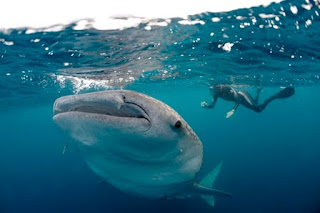
Mark with one of the early season whale sharks

Our first in water experience with a whale shark was very memorable- it was up close and personal. It took some nerve to step off the boat, into the deep blue ocean, with only snorkelling gear, whilst a 30ft shark circled the boat. Once in the water, however, I quickly relaxed. It was obvious immediately that these are gentle giants, interested in no more than peacefully feeding on tiny plankton. Their colouring and markings are beautiful; the swirls of dots and lines on the dorsal surface remind me of Native Australian art. They are extremely effective camouflage, as these large creatures disappear from view as they glide away beneath your gaze. Generally, if the encounter code of conduct is being observed, the sharks are not disturbed by the curious humans swimming next to them. In fact, as happened to me, the smaller juvenile sharks will sometimes follow the bubbles created by your swim fins, and you can circulate around your fellow swimmers with your new playful companion. That was a special experience.


'Inspector Gadget' attaches the camera platform to our Flowform kite

An interesting diversion to the day to day work with the project was an afternoon flying kites on the beach. Gareth (MCSS team leader, nickname ‘Inspector Gadget’) is trialling an aerial platform to tow behind the encounter boat, to carry a video camera. This will radio feed to a monitor on the boat, so a large area of the sea can be surveyed for spotting sharks and other fauna. Initial tests on the beach proved the kite flew well, but the platform for the camera suspended beneath the kite swung so wildly, the picture feed could cause sea-sickness even standing on dry land!

Expert kite-flyer Mark tames our Flowform 16...

A further refinement was required, by simply attaching a second kite tail to the platform itself. This did the trick of stabilising the camera to provide a steady picture. A session on the boat to fly the kite at sea then followed. However, launching a kite, with a camera platform delicately suspended beneath, carrying hundreds of dollars of video equipment, from the back of boat rolling in the swell, in a strong wind, is not an easy as it sounds... In fact, it’s very tricky! With the willing help of 3 recruits from the Year 11 at the International School Seychelles, and 3 interns, we managed to launch the kite without getting hopelessly tangled. The video results are very promising, with more testing and refinements underway. Like they say, ‘science can be fun’!

Following the successful boat launch of the kite, and even more importantly, its safe retrieval, we were lucky enough to find two whale sharks to swim with. For the ISS students, their first experience of getting in the water with these rarely seen Seychellois natives was very exciting. Big grins were in evidence on the boat ride home.

Thursday, September 8, 2011

This Is Not a Drill……..

Another intern's insight into Boot Camp, this time Samantha West relives their first live encounter...

It was the day before Whale Shark season officially began and our final practice session before taking clients out on the boat. The afternoon began with gathering all the equipment needed for a typical Whale Shark encounter including, the Secchi disk, plankton net, CTD (conductivity, temperature and depth meter), GPS and radios and of course recording sheets, fins, masks and snorkels. After loading everything onto the truck we headed to the Underwater Centre at the Berjaya Hotel Beau Vallon to get on the boat. With our trusty skipper Mervin we were shortly on our way to Conception Channel, North of Mahe, where we would be met by our micro-light pilot Johan for some whale shark encounter scenarios.

Last minute knot tying practise with Gareth and able assistant Honey, the team mut!

We divided the roles on the boat so that Leah began with radio and recording, with the help of team leader Abi, Gareth (team leader) was spotter and Mark and I were the ‘clients’. Unfortunately Susie was unable to make it due to her un-cooperative back.

Sam in charge of GPS and recording functions... when all was calm!

“Right 10°, 500m” says Johan. We are on our way, after confirming that it was a practice shark. The boat turned off the engines 50m away from the ‘shark’ and we entered the water for a pretend snorkel. Unfortunately the fake shark didn’t stick around for long and we were back on the boat in no time at all. Immediately after returning to the boat Leah gets the message “Left 5° 200m” followed by “This is not a drill…I repeat…this is not a drill”.

The frenzy began, our first REAL whale shark encounter. The radio was swiftly passed to Abi and all jobs abandoned as the three of us interns were getting in the water no matter what. The splash of the water as we were dropped in next to the 9.5m whale shark was quickly followed by an exhilarating experience of swimming alongside the worlds largest fish.


And here he is, sey.2011.004 a new shark to add to the Seychelles database!

The rest of the afternoon also saw us in the water next to a 4m whale shark and conducting some science experiments for later analysis.

Jubilant interns after seeing their first whale shark

It was a day of firsts for me. Not only was it my first whale shark sighting, it was also the first time I heard the sound of Leah squealing through her snorkel, something I wasn’t sure was possible until now.

A day full of screams, laughter, joy and overall an amazing experience. One of many more to come.


Wednesday, September 7, 2011

The Interns Emerge.... Week 1: 22-28 August


Well they all survived, mostly intact! Here's intern Susie Lilley's first ever internet blog... find out what happens during 'Boot Camp'.....

Our first day as Interns started with our first lecture from Dr David Rowat (or Dr D), this was to be our morning routine for the next week.

Our first lecture was on an overview of Whale sharks in the Seychelles filling all us ‘Newbies’ in on all things Whale shark. This was followed by an extremely exhausting (cough cough) afternoon of snorkelling with Gareth, one our team leaders. His main aim was to find out how competent we were are duck diving, as this is required to get the ID shots for each shark....more on this later.

Having shown Gareth our prowess at diving to depths of 5m+ we spent the rest of the time checking out the local wildlife and finding the elusive resident Turtle. With a beer on offer to the first person to see him, the chase was on, however the title of ‘MCSS Turtle Spotting Champion’ was retained by Gareth ‘speedy’ Jeffreys for another year.

The rest of our week followed much the same pattern, with Lectures from Dr D in the mornings covering such topics as Aerial Survey Techniques, Catch, Mark and Recapture including population estimates, Satellite tagging and Laser photo techniques. Afternoons followed these by practical demonstrations on Laser Photography in the bay in front of the office with Gareth– finding our first (pretend) whale shark that let us practice our duck diving and photographing (sounds easy but trying to photograph whilst holding your breath and trying to stay down is a lot harder than you think, and this was just practice on a stationary whale shark) ......eek! Imagine what its going to be like when it’s a real one moving at speed!

Laser Camera used to ID Sharks

Other afternoons were spent in the office working through the procedures and paperwork that we have to do on a daily basis. Learning how to radio to the pilots and fill out the correct information, learn the boat procedures for when both MCSS staff and clients are onboard.

Wednesday is when the fun started, learning how to Identify the sharks using the I3S system. Each shark has its own pattern of spots, stripes and markings, this is the sharks ‘unique fingerprint’ and it is this that allows Abi and the team to discover whether its a new shark is in the area or whether its a returning shark from previous years. This ‘fingerprint’ is taken from a triangle taken from the top to the bottom of the last gill slit to the end of the pectoral fin.

Abi teaching Mark and Sam how to photo ID whale sharks

This fun day was followed up by the Interns first trip to the Bazaar in Beau Vallon, followed by a few rounds of pool at the local hotspot La Faya. This is also the day I annoyingly managed to partially slip my disc and have therefore been office based ever since.......

Relax time at the weekly Beau Vallon Bazaar

Thankfully we had the whole weekend off (our last one for 2 months – eek) before starting again next week when hopefully everyone, except me :-( would get out on the boat for training and get to see their first Whale Sharks up close....

Sunday, August 28, 2011

That time of year again.....

The magical time of the year is upon us once again... that’s right, WHALE SHARK SEASON! Our four ready and willing interns arrived last week. They are, in no particular order...

Leah with a little reminder.....

Leah Myer, taking time out from her biology studies in America to follow her love of big spotty fish across the Pacific, bringing with her a never ending supply of small pink jelly fish sweets!

Mark working hard on his day off....

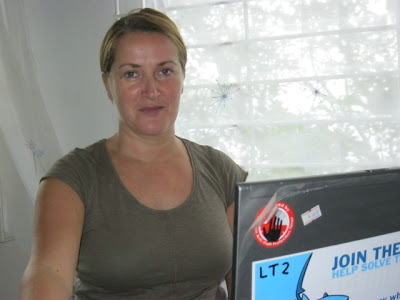
Mark Rutherford, an ex air traffic controller from the UK, now on a quest to find out what he wants to be when he grows up!


Susie mastering the I3S process
Susie Lilley, a Scottish lass who’s accustomed to Seychelles life, having completed internships with GVI and as a dive master with the Underwater Centre earlier this year.


Abi, Sam and Leah checking out the weekly 'Bazzar'

Sam West, a Tim Tam loving Australian, marine biology graduate, who also survived life as an intern alongside Susie this year.

Joining us later in the season is intern Darren Whitehead from the UK, who has experienced our big spotty friends in the Philippines, volunteering with the WWF whale shark programme in Donsol.

After their last weekend of leisure, they started training on Monday.... also known as 'Boot Camp'! This consisted of the introductory whale shark talk by Dr David, a long lunch followed by an afternoon’s encounter with their first whale shark (albeit a fake one!). Team leader Gareth Jeffreys took the interns snorkelling, showing them how to lead an in-water encounter and collect the vital whale shark information. The day concluded with a relaxing team snorkel, with Gareth retaining his ‘who can see a turtle first’ badge!

The first snorkelling session, right in front of the MCSS office, so they're easy to keep an eye on!

The rest of the week consisted of morning lectures by Dr David and more training. Team leader Abi March taught the interns the office based skills needed for collating and analysing data collected, and shared her love of the I3S photo ID software. Gareth led training in the art of lasering a whale shark –not as painful as it sounds- a tool to gain an accurate measurement of the shark.

Photo ID practice on our 'dummy' whale shark... got to get it right for the real thing!

While the interns were excelling in learning new skills, our pilot Johan Anderson got the microlight in tip top flying condition with the help of fellow pilot David Daniel. During the season, Johan will be conducting aerial surveys and assisting the boat with the encounter trips, alongside pilot Dirk van Loggrenberg, who joins the team in early September.

Gareth and team at the end of the first session ....

In the last few days, test flights have been made and whale sharks have been spotted! If things continue as they are, it looks like this is going to be another great season!

Thursday, August 4, 2011

First Shark ID'd for 2011

Our first big spotty visitor to the Seychelles this year has now been identified! On Monday 25thJuly, Global Vision International (GVI)were out at sea conducting their weekly plankton tows when the unmistakable spotty shape swam by. On board was staff member and fantastic photographer Joe Daniels, who is trained in the art of whale shark snorkelling and ID photography having completed his whale shark internship with MCSS last year.


With a few of the team on board, he entered the water and, following the whale shark code of conduct, managed to snap a left and right side of the shark. Later, GVI sent the images on to us and we were able to identify the shark as sey.2006.054.


This shark is a male, estimated to be about 4m and was first seen in 2006, then again in 2008 and 2010. The shark hung around with the snorkelers for about 5 minutes before diving. He was accompanied by about 25 remoras (shark suckers who accompany large pelagic animals) and had no noticeable scars. As later this month will see our whale shark interns arriving, we hope our early visitor is a sign of a great season to come! Thank you to GVI and Joe for their encounter details and photos, great job! To see more of Joe’s spectacular photography visitwww.jldaniels.co.uk

Saturday, June 4, 2011

Djibouti 2011 Interim Results


Well after many months of hard work the raw figures are at last in!

Djibouti 2011 was indeed another record breaking season for MCSS, not only was it the first three week programme planned to this remarkable area, but it yielded the highest numbers of sharks and encounters recorded yet. In total 114 sharks were individually identified during the three six-day expeditions from a total of 1236 encounters! One shark, a female first sighted in 2009, was seen on 13 of the 18 days of monitoring.

As you can imagine working through this sort of volume of data was a Herculean task; sorting the large numbers of digital images alone that accompanied each encounter, sometimes as many as 60 images from a single encounter was an epic task in itself. For this we are grateful as ever to Team Leaders Abi March, Ciara McCarten and Gareth Jeffreys for their huge contribution on site and to Abi for her dedication after the expedition to sort out and run each encounters' photos through the I3S matching software.

Also deserving of our thanks is MCSS volunteer Inga Petelski who has been assisting us since the beginning of March and who has had the un-enviable task of digitising the hard copy encounter sheets for each day into our Djibouti data-base. The highest number of encounters recorded in a single day was 148, with three days exceeding 100 encounters, so it was indeed a very busy season for the team!

The other data sources are also becoming finalised; both of the two Wildlife Computers Mini-Pats successfully detached and transmitted their data, one after two weeks of deployment and the other after 12 weeks. Both tags popped-up fairly near the sites where the sharks had been tagged but we are waiting to see what the data tells us about their movements during the period of tag deployment.

Also in are the data from the plankton tows which were analysed by Dr. Dave Conway at the Marine Biological Association of the UK, Plymouth; he has given us a full taxonomic breakdown of the samples along with size classes for the most common species. As in previous years there were large numbers of big fat Chaetognaths (Flaccisagitta enflata) as well as a lot of gelatinous material from pelagic tunicates (Larvaceans).

Pelagic larvacean similar to those in our plankton tows

He also analysed two whale shark ‘poo’ samples for us that we were fortunate enough to collect and found that they both had large numbers of chaetognaths (and chaetognath teeth, as the bodies had been digested) and surprisingly large numbers of crab larvae. We had noticed that on several days there were massive numbers of swimming crabs present which we presume must have been spawning, however, the straight plankton tows captured very few of these larvae.
The arrow worm or Chaetognath was common in all samples, including the 'poo'!

So there is still a load more work to do on the analysis of the data but the raw data is now compiled and we look forward to teasing out its secrets!

Saturday, March 5, 2011

The quiet season….

The months between the end of the Djibouti whale shark season and the start of the Seychelles whale shark season are often thought of as the quiet months but in reality they are some of our busiest in terms of getting on with all the other work of MCSS.

Abi doing what she loves best, photographing whale sharks, photo Hussain al Qallaf

The analysis of the Djibouti data is on-going with team-leader Abi March stoically working through the many hundreds of encounters and thousands of images; She has completed the first two weeks of the expedition now and our total of sharks identified is 99 individuals with 56 being resightings from previous seasons compared to 43 new sharks. In terms of the ratios of males to females they remain pretty constant with 82% males to 18% females. David also has his work cut-out now as the first of the mini-PATs has now popped-up so he has lots of data to analyse…

Volunteer intern Tomoko getting to grips with the CTD

The deadline for application for the 2011 Seychelles Whale Shark Internship Programme is fast approaching (March 31st) so if you have 10 weeks to spare that you would like to spend working on these great animals you should DOWNLOAD the information file and fill in the APPLICATION FORM QUICKLY!


In other news, the project on monitoring sharks and marine life in the Bay Ternay Marine National Park is now well underway with the array of VR2 acoustic transmitters in place across the Conception Channel and Bay Ternay Marine National Park, thanks largely to the hard work of the volunteer Dive Master Trainees from the Underwater Centre and the staff of the Seychelles Fishing authority. In all 37 stations will be operating to track the movements of fish and other marine species around this area.

The Bay Ternay / Conception Channel Acoustic Array

A workshop was held in February to give staff involved with the project training in the skills for the insertion of acoustic tags into the body cavity of the fish, to minimise risk of injury to the animals and promote long-term tag retention.
Volunteer team leader Ciara and project Coordinator Georgia learn how to suture a shark after tagging

The first capture sessions were conducted over the last week or so with two groupers being the first individuals to be tagged with acoustic tags and released back into the array. So far the small reef sharks have proven illusive be we hope to rectify this in the coming weeks!