Wednesday, January 21, 2009

Dispatches from Djibouti.... 5. Volcanoes, cracks and the Devil’s Goblet...

The Gulf of Tadjoura owes its existence to the interface between two of the earth’s tectonic plates, the Southern one being the African plate while the northern one is the Arabian plate... where the two meet there is a zone of crustal instability which results in the Gulf of Tadjoura and extends down through Africa as the East African Rift valley. ‘Crustal instability’ is a nice term which includes such things as earth quakes and volcanic eruptions as the two plates move relative to each other... this is where we are!

We weren’t the only ones interested in this area as we soon met up with a BBC Natural History film crew who were going to be filming for an up-coming documentary on the East African rift and were keen to find out more about the whale sharks in the area. And so it was that Deli moved up into the western end of the Gulf into an area that has almost become a land locked lake due to volcanic activity and uplift in the area... this is the Ghoubet al Kharab or Devil’s Goblet and is an almost surreal area bounded by volcanic craters and lava flows.


The wind at this end of the Gulf was relentless, the ‘khamsin’ wind is caused by air on the mountains being in the North and West being heated more quickly than in the lower sea-level area of the Gulf and increase dramatically through the day… in the Devils Goblet they were intense as the walls of the Goblet funneled the winds from off the sea towards the mountain ranges of Ethopia.


We anchored in the lee of Devil’s Island a bizarre volcanic plug that looks like Ayre’s rock dropped into the middle of a large lake! We went out for a first whale shark survey around the island but found conditions on the up-wind side almost impossible and opted to do a plankton tow and CTD profile in the lee of the island instead, followed by a few hours exploring these strange islands.The scenery was very odd and was largely due to the volcanic bed rock of the islands which was then covered in layers of volcanic dust and ash several metres thick.


A landing expedition soon declared the discovery of the islands Apex Predator (a hermit crab) although the team were still convinced that velocoraptors were nesting in the strange round caves carved into the walls of Devils island...So that’s how we came to spend the night anchored in the lee of Devils Island, in the flooded remains of a volcano next to a lava flow that was spawned by the Ardoukoba Volcano in 1978...
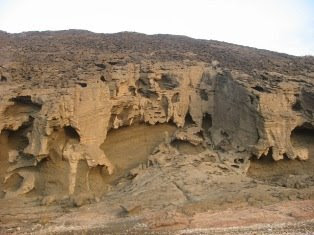

Morning arrived and we were still all safe and sound, the Devils Goblet had not swallowed us up in a lava flow and the morning Khamsin wind greeted us as we moved the Deli around the island into the area known simply as ‘the crack’ where the BBC team, Ingrid and Gavin, were filming with an ROV down into the crack between the two tectonic plates.... and apparently there were whale sharks there!


After two hours of luckless searching through the steep sided flooded calderas that are peppered around this area we returned to the Deli and paid a visit to Ingrid and Gavin to see what they were up to with their ROV. The strange contraption was returning from a dive into the crack and we found it bumbling along just above the crack in shallow water, about 25 meters from a young 3.5 m whale shark! This was soon joined by a second shark and shortly a third was seen at some distance from the boat... if the sharks were here then this must be safe after all!


However, three sharks did not a programme make and so it was with some relief that we left the Devil’s Goblet and headed back to Arta and the Ras Korali area to continue our work on the whale shark aggregation... would the sharks be there? We had had a rather disappointing day prior to heading into the Ghoubet and were worried that the massive aggregation may have dispersed for more productive areas.... the evening would tell...

Dispatches from Djibouti.... 4. Satellite tagging, plankton sampling and more

The team is getting the hang of things now and a daily routine has developed that seems to keep everyone happy and to fit in with both the boat’s schedule and the aims of the programme...

Daniel and David are the early-birds with Daniel eager to get out for an early morning whale shark session while David seems welded to the computer, matching spots on big fish... so there is usually a pre-breakfast run for the early morning team followed by two boats on the main morning survey, an extended break over lunch during which time cameras are downloaded and ‘wet’ data-sheets transcribed onto ‘dry’ permanent copies and checked, prior to the afternoon session.


The amount of data being collected is quite phenomenal and making sure it is in order and properly checked has become the priority with Katie and Luke working with each of the recorders to make sure that this side of things does not fall behind. Our new recorders were doing a sterling job with young Morgan finding that shark spotting was equally as taxing as cetacean photo IDs but with Luke and Katie’s help she was keeping the ‘French’ boat’s data in order.


The photo ID has had to take a back seat as it can only be done once the photos have been matched to each encounter record.... also there’s heaps of ID’s to fingerprint and match and this does take time; as we approach the end of the first week we already have in excess of 80 new sharks photo identified and added to the database as well as several resightings of sharks identified from previous years going back to 2003 when the programme first started in Djibouti.


The first satellite tag deployed on a very cooperative 6 m male shark


The first of the satellite tags was also to be deployed at the end of the week and the modified MK 10 PAT tag from Wildlife Computers was made ready to go on its voyage of discovery... the trouble was that David wanted to put it onto a large shark (larger than 5 m) and with eager camera teams waiting to film the process it had to be a very slow moving shark, in fact preferably one that wasn’t moving at all so that everyone could get their photos!


So with this in mind the teams set out in the afternoon to find a shark to meet David’s exacting needs which seemed to be a bit of a tall order as most sharks being found were around 3 metres in length.However, finding slow sharks proved not to be a problem as the afternoon feeding aggregation was kicking off nicely and many sharks were already into vertical feeding mode where they stay stationary for several minutes at a time just gulping in great mouths full of plankton....


Fortune was smiling and a 6 metre male shark was found placidly vertical feeding off Acacia Beach who didn’t even flinch as David attached the tag.... in fact the shark ignored the whole process and just continued gulping which seemed a little ungrateful! So the first tags is out and alive and we hope to start to get regular updates from the tag as well as its full story when it pops off in three months time.


Talking of gulping plankton, the team has been busy trying to find out exactly what the sharks are gulping by running surface plankton tows and conductivity, temperature and depth profiles.... these too had to be modified from the standard five minute tow to a much shorter two minute tow as the volume of plankton being collected was simply too much to process and we had a limited number of plankton sample pots! What was very apparent was the high number of arrow worms (chaetognaths) and sea-butterflies (pteropods) present which are regarded as prime whale shark food in the Seychelles; and while we don’t yet know the species of the arrow worms these guys were huge compared to those found in Seychelles and so it’s no wonder the sharks here seem to be in vertical feeding mode so often.... all will be revealed when the samples get to the lab!

Wednesday, January 7, 2009

Dispatches from Djibouti.... 3. Things that go bump in the night


After the first hectic day everyone was looking forward to a relaxing evening, except the MCSS team who were contemplating what exactly what to do with the reams of data that were being captured..... that was until Dan announced he had brought out a special light for attracting whale sharks at night, he apparently didn’t see enough during the day!


Dan, Tom and the Captain Armand set about mounting the special light on the suspended gangplank off Deli’s back deck and once the 1000 watt monster was powered up it soon attracted a dense cluster of plankton and in a short while a school of small fish, a few larger fish but no whale sharks.... So back to the data entry for an hour or so before a well deserved sleep!


Day three arrived very early for some with Daniel taking his first group out at 06:30 to welcome the sharks at dawn.... the rest of the day followed the same pattern as the previous day with morning and afternoon whale shark monitoring sessions, but this day was less hectic with 21 encounters in the morning and 27 in the afternoon and a total of 17 biopsies taken.


Suction feeding whale shark off Acacia beach, Djibouti, photo Luke Riley


Dan and Tom once again set up the ‘mega-light’ and again managed to attract a healthy cloud of plankton and lots of appreciative small fish.... but nothing larger. Dinner was almost over when someone happened to notice that there was a large shape swimming around in the beam of the flood-light, a young whale shark had appeared to take advantage of the free dinner service!

All thoughts of post dinner relaxing soon evaporated as people scrambled to get masks, fins and cameras as a second whale shark turned up to assist in the clean-up below the light.... Almost everyone got time in the water with one or the other shark and captured some quite unusual images of them. Almost everyone, as it took Dan some time to get his camera and housing organised only to find that as he entered the water the housing alarm sounded indicating the housing was leaking somewhere and so he had to abort his attempt.


A young whale shark vertical feeding on plankton attracted by the Megalight, photo Luke Riley


By this time one shark had departed but Tom and a few of the team spent several hours with the one who remained.... finally the shark tired of the attention and everyone was able to go to sleep!

The war on data was continuing and we were finally able to catch up on some of the photo ID matching and confirmed 29 individual sharks in the second ‘Manic’ session on the previous day including 4 re-sightings from previous years, 1 from 2003, 1 from 2004 and 2 from 2007...


Dispatches from Djibouti.... 2. Whale shark madness!

At 06:30 on the first morning the whole team were up and raring to go as we boarded Deli’s support tenders and headed across Arta Bay towards the French Foreign Legion camp where in 2006 we had regularly encountered whale sharks..... and sharks there were! Between the two boats we achieved some 18 photo ID encounters (later confirmed as 8 individuals) with the characteristically small whale sharks found around Djibouti and so the expedition was off to a very good start.
On returning to Deli for breakfast we were told that another live-aboard was seeing lots of sharks in the next major bay further west and so we felt obliged to move Deli down to this area for the next session. Heading out in the tenders again we were keen to see if the reports of a big feeding aggregation off Acacia beach were true and much to our surprise they were! There were whale shark tails and dorsal fins everywhere....

What is the collective noun for a group of whale sharks? A Shed Load seemed appropriate!

Luke and David were on photo ID duties while Katie drew the short straw of recording by default, she had brought along a UK cold and so was out of the water for a few days.... just as well as the boys notched up a total of 62 in-water photo ID encounters in two and a half hours.... I think the expression used was Manic!! Dan and Tom, the two cameramen from Save Our Seas were suitably impressed but were heard muttering about too much plankton, too many sharks, swimming too fast, not enough time, not enough sun, too much sun etc. etc. While on the other tender Daniel Jouannet from Megaptera with Luis, Flora and their son Germinal were matching David and Luke shark for shark with both photo and video IDs.... The only really unhappy voice was Katie’s as she was forced to sit on the boat and watch but after much pleading she was released to play in what she called a ‘whale shark sandwich’ (take three whale sharks and one Katie and press together)!

After the adrenalin rush of the last two and a half hours, the return to the boat was a somewhat subdued affair with the dawning realisation that writing up the data sheets for 62 encounters was going to take many hours, not to mention working through the photos and running them through the I3S photo ID program. We were going to have to re-think our approach for the afternoon as both Luke and David knew they had multiple encounters with the same sharks although there were obviously many different sharks around.


For the third and final session of the day it was agreed that a combined photo ID and biopsy routine would be run with Luke taking the photo IDs, David taking biopsies and Katie keeping track of everything on the record sheets. So session three in the afternoon was awaited with a mixture of excitement and dread as if the same encounter level was maintained the next two weeks were going to be spent working through the data instead of photographing more sharks! The afternoon session was busy but nowhere near as manic as the previous one... there were lots of sharks around but the feeding frenzy had abated to some extent and the photo ID / biopsy approach slowed down the speed of activities and ensured the maximum amount of data was captured; in total 27 sharks were encountered and 10 biopsies taken.

A daily work-plan was developed so that tasks that needed to be done immediately were taken care of, such as writing up the data sheets and separating out photos for each encounter; the back ground tasks of fingerprinting and photo ID matching would be done on an as and when possible basis...

All photos courtesy Luke Riley

Dispatches from Djibouti.... 1. Arrival


Well we all made it here safe and sound; after journeys which all seemed to include compulsory visits to several African countries to make connections, arrived at the small but efficient airport at Djibouti. Over a three day period, the expedition participants from Australia, France, Seychelles, South Africa and the UK all managed to convene at the correct hotel in Djibouti without having lost any baggage.... well one camera case did pay a fleeting visit to Somalia on its own but found its way to us in time!


Those of you who dread baggage weighing at international flight check in counter would have had nightmares as Katie and David checked in some 80 Kgs for the flight from the UK on Kenya Airways but this was well within the 45 Kgs each they were allowed so that was fine. Save Our Seas H.D. video cameraman Dan Beecham was ‘traveling light’ this time as it was a live-aboard expedition and so he only had 350 Kgs of equipment while Thomas Peshak the Save Our Seas chief photographer had a mere 120 Kgs!


Day one was spent chasing down the material we had not brought with us and we expected to have problems buying Formalin, a listed poison in many countries, which we needed for plankton preservation,..... However, to our surprise the local pharmacy knew exactly what we needed and had stock on the shelf. A quick visit to the local hardware shop secured a suitable rope for plankton tows and CTD casts and so we were all set for the off.

Le Petit camion struggling under Dan and Tom's kit


Loading up the ‘le petite camion’ with the Save Our Seas baggage was interesting, luckily several other 4 x 4s were on hand to handle everyone else and their kit and we were soon aboard the Deli getting settled in and sorting out equipment and eager for the first whale sharks! The crew were confident that we would get loads of sharks but confided that we ‘should have been here two weeks ago’ when they had seen an aggregation of over 40 whale sharks........ as we left the dock we were still in good spirits but blaming the ‘curse of the photographers’ for chasing the sharks away as we motored off towards Arta and Djibouti’s whale sharks!

Saturday, December 27, 2008

A Happy New Year To All!!

We wish all our visitors a safe, happy and prosperous 2009!

We will not be able to add new posts to the blog over the next few weeks while the team is out on the research expedition to Djibouti, but we will update you as soon as we are able!


In the mean time have a great New Year!

Monday, December 15, 2008

Djibouti expedition draws near

As most people get into the pre-Christmas rush of last minute card writing and present buying scattered around the world a dozen or so people are getting excited about another activity to take place shortly afterwards, the whale shark expedition to Djibouti starting on New Years Day!

Both of the two weeks of the expedition are now fully booked with the team from MCSS and Megaptera being joined by cameraman Dan Beecham and photographer Thomas Peschak from the Save our Seas Foundation as well as a total of some six eco-volunteers. Life aboard the Deli is going to be pretty hectic from the sound of things…

The expedition is going to be targeting the Arta area in the Gulf of Tadjoura which is the gulf on which Djibouti city is located just past the southern end of the Red Sea. This gulf is an inlet of the Indian Ocean caused by the fault line of the northern end of the great East African Rift Valley that transects Djibouti, Ethiopia and Kenya.

The area is geologically and volcanically active as evidenced in 1978 by the eruption of the Ardoukoba volcano. The seabed shelves steeply from the coast of the Gulf dropping to 100 m depth around two km offshore and to around 450 m depth in the centre of the Gulf of Tadjoura. The volcanic lanscape is dramatic if somewhat stark and the volcanic activity has narrowed the gulf down to form the ‘Devils Goblet’ and then pinched it off entirely leaving Lac Assal completely land locked and evaporating away. The surface of this lake is now 450 m below sea-level and the evaporating seawater has left vast salt pans with dramatic areas of salt crystal structures; this is a must for all visitors to the area and a half day trip has been planned.

The whale sharks in Djibouti are interesting in that they spend a lot of time vertical feeding and at night are drawn in to feed on swarms of tropical krill that are attracted by the boats lights...

Five whale sharks feeding on tropical krill at night... not quite sure how we would get the photo IDs done on this lot!

Off special interest to the whale shark team is the fact that very deep water is close to shore. This feature coupled with the fact that on the previous expedition in 2006 the aggregation of sharks was found to be composed of very small sharks, with several of just over 2 metres, may indicate that this area may be a nursery ground for whale sharks. The rationale for this is that globally the number of neonatal (less than 1 metre) whale sharks seen is tiny, less than 15 records, this despite the high level of fishing in coastal areas. This has prompted the idea that when first born the 65cm pups stay
in very deep water to keep away from other predators and only come into shallow waters when they are around 4 m in size. Djibouti with its aggregation of very small sharks may thus be an area close to where the youngsters are.

While our team aren’t able to get to those sorts of depths, an ROV can and the BBC Natural History film unit just happen to be in Djibouti at the same time and happen to have an ROV! Their main aim is to explore the beginning of the East African Rift but having heard of our expedition and the potential of this being a nursery area they are going to see if they can find any baby whale sharks at the same time!


So this really is going to be quite an adventure... we will post news to the blog but as there is no internet connection it will probably be once we get back to civilisation...